

By Raquel Rogers | Houston Defender | Word In Black
This post was originally published on Defender Network

(WIB) – When Tanisha Tate’s phone rang on Aug. 16, 2013, she had no idea the call would alter the course of her life.
That day, her vibrant, energetic mother collapsed in a parking lot. Tests revealed a brain tumor—meningioma—that would require surgery.
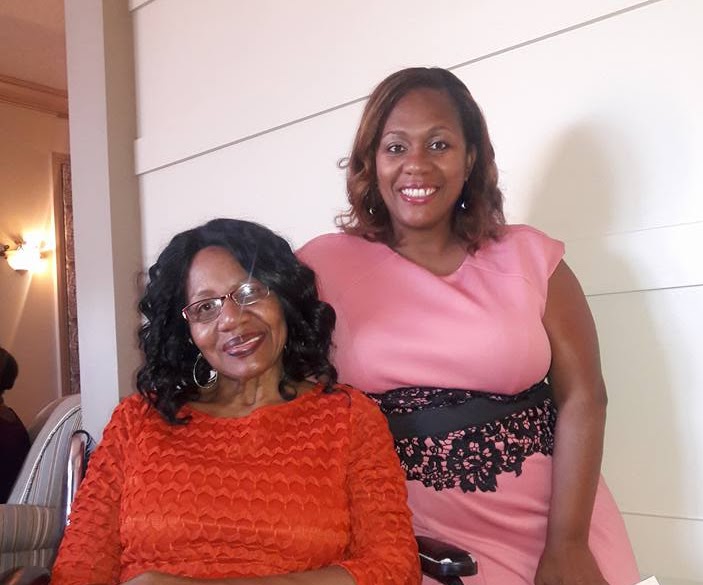
The operation was successful in removing the tumor, but a devastating stroke during the procedure left her mother hospitalized for nine months. In the aftermath, she lost the use of her right side and her speech and now suffers from Aphasia, a communication disorder that affects a person’s ability to speak, understand speech, read or write.
“We went through eight different hospitals and rehab facilities before my sister and I decided she would come live with me,” Tate recalled. “It’s been 12 years of ups and downs as we learned to accept our new reality.”
That reality is filled with challenges, love and—thanks to her mother’s personality—more than a few moments of humor.
“Anyone who knows my mom knows she may have lost her speech, but she hasn’t lost her spunk. She’ll get you together real quick—in gibberish,” Tate said.
Learning Through Living

Tate’s caregiving journey didn’t just change her life—it became the foundation for her new book, Who Cares for the Caregiver. Written with equal parts honesty and compassion, the guide pulls back the curtain on the parts of caregiving people rarely talk about: The exhaustion that creeps in after long nights, the loneliness of feeling no one else truly understands and the tightrope walk between giving your all to someone else and holding on to your well-being.
In the book, Tate breaks down the realities she’s lived for more than a decade. She explores how to spot the early signs of burnout before they spiral into emotional or physical collapse. She shares simple, practical self-care techniques—like five-minute mindfulness exercises, short evening baths, or carving out time for personal goals—that don’t require money or major planning. She talks about the importance of communication, even when it’s uncomfortable and about building a circle of people who can lift you up on the days you feel you can’t keep going.

It’s a message she’s earned the hard way. “I’ve been a caregiver now for a while, and I get questions all the time: How do you do it? How do you manage? Who comes in to give you relief?” Tate said. “So I wrote this book because I was getting so many questions, I felt passionate about sharing my story so more people could learn from my struggle.”
The struggles have been many. Over the years, Tate has juggled scheduling doctors’ appointments, battling with insurance companies, navigating complex hospital systems, paperwork and managing her mother’s rehabilitation transitions—all while working full time and raising her now 21-year-old son. She’s endured logistical headaches, physical exhaustion and moments when self-doubt threatened to take over.
But she’s also learned how to adapt, how to advocate fiercely, and how to find resilience when she thought she had nothing left to give. Who Cares for the Caregiver is as much about those lessons as it is about survival—it’s a book born from lived experience, offering fellow caregivers a reminder Tate wishes she’d had in the beginning: caring for yourself is not selfish; it’s survival.
Who’s Caring for the Caregiver?
It’s easy for caregivers to lose sight of their own needs—not just emotionally, but physically and financially too. The numbers from the Bloomberg School of Public Health tell a powerful story:
- In the U.S., more than 105 million adults provide care to a relative—often unpaid—with 53 million caring for a spouse, aging parent, or special-needs child.
- Since 2011, the number of family caregivers supporting older adults has surged 32%, from 18.2 million to 24.1 million, and the time spent caring for them has nearly doubled, averaging 31 hours per week in 2022.
- Caregivers frequently juggle work and caregiving: 67% report difficulty balancing both, while 27% reduce work hours, and 16% step away from their careers entirely.
- AARP’s 2025 report estimates 63 million family caregivers in the U.S.—most unpaid, many overwhelmed; only 11% had formal training, and nearly half are handling high-intensity care.
These figures make clear a sobering reality: Caregivers bear a tremendous personal toll—emotionally, physically, financially—and far too often are left to do so alone.
Self-Care as a Lifeline
One of Tate’s most urgent messages is this: Self-care isn’t optional—it’s essential.
“The biggest takeaway I want caregivers to have is that at some point, you have to put you first,” she said. “It’s a physical, mental and emotional toll. You can’t take care of others if you’re not at your best.”
As someone in the so-called “sandwich generation,” Tate knows this balance too well. Raising her now-21-year-old son while caring for her mother has tested her in every way.
I make time for what makes me happy and I don’t worry about what anyone thinks. I know in my heart that my mom would do the same for me. – Tanisha Tate
“You have to do little things every day,” she advised. “That doesn’t mean a trip or a massage every day, but it can mean a five-minute prayer or taking a bath every night. Something that lets you wake up refreshed and ready to tackle the world.”

“I’ve watched Tanisha navigate this journey and I’ve been amazed at how no matter how frustrating it gets for her, she has mastered the ability to push pause and take care of herself,” said her friend Jodi Williams. “I always feel like the guilt would wear me down if I was in a similar situation.”
Letting go of guilt became Tate’s breakthrough. “A wise person once told me, ‘You can’t pour from an empty cup,’” she said. “That’s advice I live by. I make time for what makes me happy and I don’t worry about what anyone thinks. I know in my heart that my mom would do the same for me.”
While caregiving is “not for the weak,” as she puts it, Tate embraces the role fully. Now, through her book, she hopes to offer other caregivers something she once had to figure out on her own—a reminder that they matter, too.
Who Cares for the Caregiver is available at www.Amazon.com.
Tanisha’s Top Caregiver Tips
1. Put yourself first—without guilt.
“You can’t pour from an empty cup,” Tate says. Caring for yourself is not selfish—it’s essential.
2. Do something small for yourself every day.
It doesn’t have to be big or expensive—take a bath, say a prayer, read a book, or go for a walk.
3. Accept your emotions.
Caregiving brings a mix of feelings, from frustration to joy. “It’s okay to feel whatever you need to in order to sustain.”
4. Find your balance.
Create boundaries to have your own life while still showing up for your loved one.
5. Tap into your support system.
Don’t be afraid to ask for help from friends, family, or local caregiver networks.
6. Remember the humor.
Moments of laughter—planned or unexpected—can keep you going in tough times.
7. Know you’re not alone.
Millions of Americans are part of the “sandwich generation,” caring for both aging parents and children. Sharing stories builds community.